
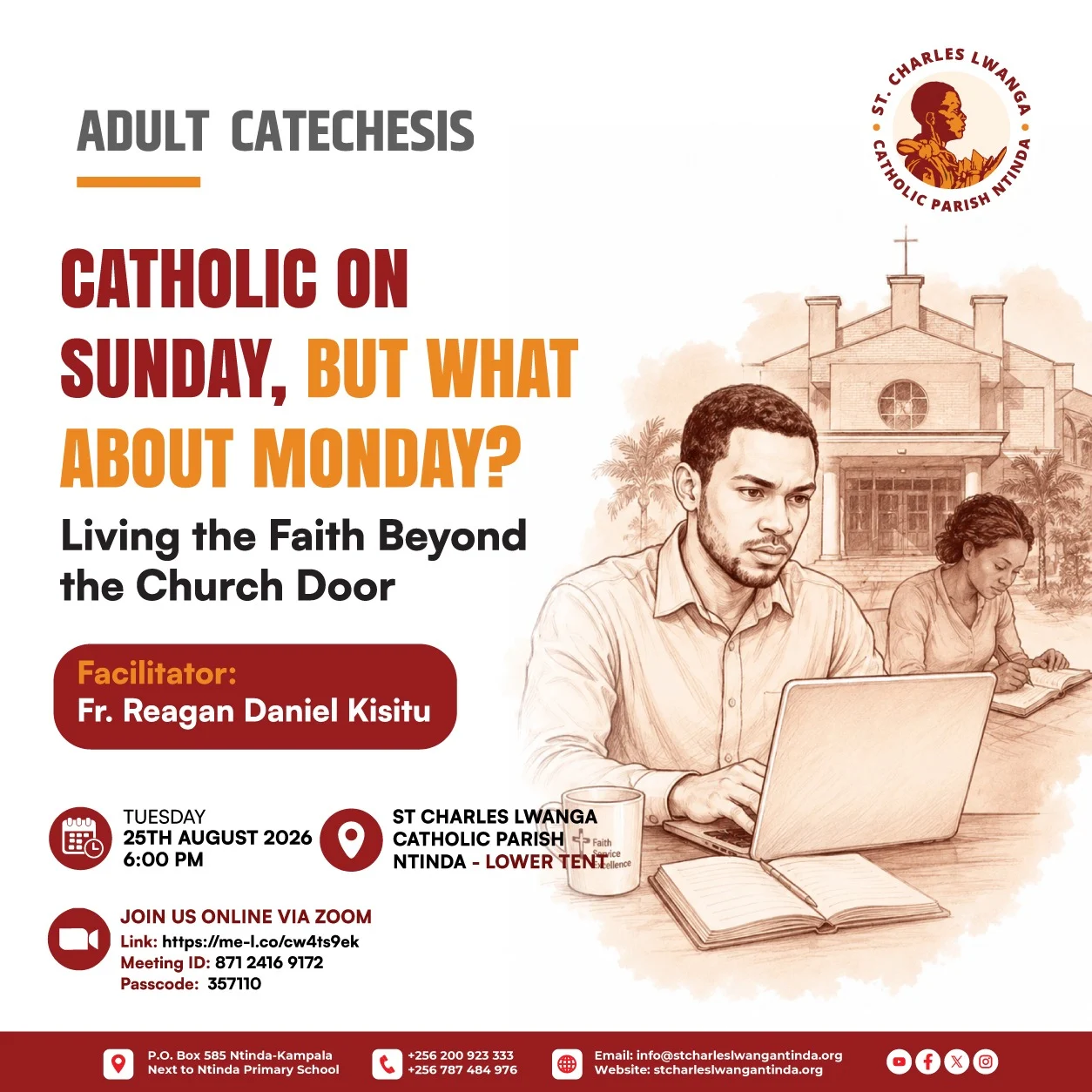
Have you ever wondered why many of us wear our most spiritual hearts only on Sunday, and by Monday, we don’t act like we encountered the Lord just yesterday?
In the recent episode of our monthly Adult Catechesis conversations, Rev. Fr. Reagan Daniel Kisitu walked us through this reality.
He started by reminding us why Sunday matters so much in the first place. The Catechism calls it “the pre-eminent day for the liturgical assembly” (CCC 2177), and canon law is clear that the faithful are bound to be at Mass on Sundays and holy days of obligation. He traced this all the way back to scripture: God telling Israel in Deuteronomy to “observe the Sabbath day, to keep it holy” (5:12), and Exodus calling the seventh day “a Sabbath of solemn rest, holy to the Lord” (31:15). The Church keeps that same rhythm now on the day of Christ’s Resurrection, the Lord’s Day, since Sunday is the fulfilment of the Sabbath and a sign of Christ’s Passover, the “first day” of the week on which the tomb was found empty.
So Sunday is a must, he said. But what about the other six days? He brought us back to the most basic question the Catechism asks: why did God create you? To know Him, to love Him, to serve Him, and to be with Him forever. That answer, he pointed out, was never meant to apply to just one day a week.
From there, he addressed a misconception many of us carry without even realising it: that the Catholic faith is rigid, a religion of rules, hierarchy, and ritual. It is not a religion of the book, he said. At the centre of it all is a Person, Jesus Christ, the ultimate revealer of the divine mystery and its encounter with humanity. Our faith isn’t a finished transaction. It’s an encounter of becoming, and that becoming is the universal call to holiness.
The Three Stages of the Spiritual Life
This is where Fr. Kisitu really opened things up for us. He explained that our spiritual life begins at Baptism and unfolds as a journey, one meant to lead us to know, love, serve, and be with God forever. Drawing on Catholic mysticism, especially St. Teresa of Ávila and St. John of the Cross, and on Adolphe Tanquerey’s 1930 book The Spiritual Life, he walked us through three stages of that journey. Each one, he said, really comes down to a single question: who is Jesus for me right now?
The first stage he called the Purgative Stage, or “Leave Me,” the stage that purifies the senses. Here, he explained, the driving force is avoidance of punishment rather than love. Prayer becomes mostly “give me,” and faith gets expressed through attendance, giving, andmoral support, while a real gap opens up between what we profess and how we actually live. He described two sides to this stage. In passive purgation, prayer feels dry and boring, and hardship gets read as punishment, “what did I do to God to suffer this much?” This is the Dark Night of the Senses, where God is experienced as a policeman or judge, and prayer starts to feel like a police case. In active purgation, though, there’s a real willingness building toward discipline, repentance, fasting, and examining your conscience, even if your commitment to the faith is still mixed. Throughout this stage, he said, the real battle is between pleasure and faith. Prayer runs on intensity rather than consistency, faith becomes a way to feel at peace rather than a relationship, and the temptation is always to give up, because sin is sweet.
The second stage, he told us, is the Illuminative Stage, or “Follow Me,” which purifies the mind. Here the fight shifts, he said, from avoiding mortal sin to genuinely pursuing a virtuous life. Prayer becomes more of an encounter with God’s presence, moving past discursive meditation into a real willingness to respond to His will. The mind starts asking honest questions about the faith, seeking to understand rather than simply obey. He named two things doing the work of this stage: recollection, a constant awareness of God carried through daily life, and infused knowledge, a genuine hunger to know the faith more deeply, which brings real peace, humility, and contentment, even as new temptations creep in, like spiritual pride or a quiet self-love. This stage, he said, eventually turns toward learning to love the good, and with that comes the Dark Night of the Spirit, where the temptation is to stop altogether because it feels like God has gone silent. And yet, he said, that very dryness deepens our thirst for God. Jesus starts to look less like a judge and more like a saving friend, prayer becomes a daily need rather than a duty, and mortification, once resisted, becomes bearable.
The third and final stage is the Unitive Stage, “Abide in Me,” which purifies the heart. Fr. Kisitu described this as the union of wills, a transforming union marked by growing charity and action that never stops. Prayer becomes, as St. Padre Pio put it, the oxygen of the soul, sustained by consistency rather than intensity. This, he said, is the stage of Christ’s own words: “Remain in me as I in you” (Jn 15:4), “Remain in my love” (Jn 15:9). Suffering doesn’t disappear here, he told us, but it no longer divides us from God. Love for enemies becomes natural, not heroic, because Jesus Christ has become both the highest good and the common good sought in everything. “Jesus, I trust in You” becomes the motto of it all.
He closed that section with a quote from St. John Eudes that stayed with many of us in the room: “As we give ourselves to Christ, our hands become His hands, our heart is transformed into His heart,” or, “Jesus wants His breath to be in your breath, His heart in your heart, and His soul in your soul.”
The Waves Working Against Us
Fr. Kisitu then named a few currents he said are quietly working against this journey, even for those of us trying to grow. He spoke about an exaggerated search for miracles, where faith stays stuck on the receiving end, “what do I get by coming to church?” He spoke about the prosperity gospel, where a vision of success blurs our sight of the faith itself, loving mammon at the expense of God while still claiming to follow a crucified Christ. He quoted St. Maximilian Kolbe here: “The Cross is the school of Love.” He also named secularism, the shrinking of religion’s place in ordinary life, and religious syncretism, where faith in Christ gets quietly blended with practices like witchcraft, often out of fear or a desire for protection and dominance. And he pointed to a lack of ultimate purpose, where the glorification of work leaves us with tired bodies and empty souls, chasing romantic obsessions and a “vibe-up” kind of faith instead of the real thing.
Being Mary in a Martha World
He brought it all home with the familiar story of Martha and Mary (Lk 10:38-42). Many of us, he said, are lost in that same activism today, treating faith as an afterthought, a footnote, another weekend outing, busy with everything the way Martha was, except the one thing that actually matters.
He left us with a few practical anchors: sanctify your work, your home, your routine, because ordinary life is the material of holiness, not a distraction from it. He quoted St. Augustine of Hippo, who said that as the soul is the life of the body, so God is the life of the soul, and the soul only acts perfectly when it acts through charity. And he reminded us that love is the greatest commandment, quoting St. Thomas Aquinas’s definition of love as willing the good of the other, in its three forms: amor, the broadest, an appetite for the good; dilectio, love exercised with choice and reason; and caritas, the highest form, entirely selfless and self-giving.
He closed simply: God is the highest good, the one thing worth seeking in everything else. Jesus wants our story to become His story, our life to become His life. Just as Christ took on our humanity, He now invites us to share in His divinity.
That, in the end, was his answer to the question we opened with. Being Catholic on Sunday means very little if it doesn’t carry us into Monday.